
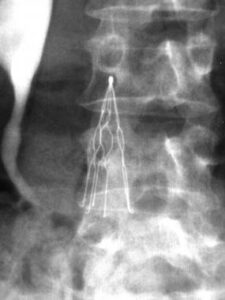
 The results of new research presented at the 2017 New York Surgical Society Meeting suggest that inferior vena cava (IVC) filters may increase the risk for venous thromboembolism in patients with traumatic spine injuries.
In conducting the research, surgeons from the Jacobi Medical Center and Yeshiva University’s Albert Einstein College of Medicine studied the medical records of the American College of Surgeons’ National Trauma Data bank over a four-year period, identified 69,000 patients with traumatic spinal cord injury, and analyzed the outcomes of those who had received IVC filters. According to the study results, slightly over 10 percent of those who received an IVC filter sustained a pulmonary embolism, while only 7.6 percent of patients who were treated with chemoprophylaxis experienced a pulmonary embolism.
What are IVC Filters?
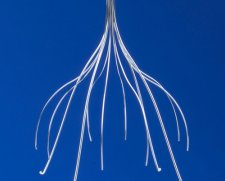
Inferior vena cava (IVC) filters are tiny, cone-like devices that are inserted into the vena cava to catch, or capture, blood clots that have broken free from one of the deep veins in the body and prevent them from reaching the lungs, where they could cause a pulmonary embolism. Despite the fact that these clots can cause permanent damage to the lungs as well as other organs of the body, half of those who suffer a pulmonary embolism have no symptoms.
IVC filters are to be implanted for only a limited amount of time and then removed when there is no longer a substantial chance of pulmonary embolism. But according to the U.S. Food and Drug Administration (FDA), the majority of IVC filters are not retrieved, despite the risks of leaving them in place, and there are currently no guidelines on the time frame during which IVC filters must be retrieved from the body.
Other IVC Filter Lawsuits News

An Arizona judge denied class certification for Bard IVC filter lawsuits, citing differences among plaintiffs' devices and claims. These lawsuits allege serious injuries from defective IVC filters and insufficient risk warnings.
Studies reveal that Cook Medical’s Celect IVC filters may puncture the vena cava within two months, leading to serious complications and fueling thousands of lawsuits alleging defective design and failure to warn.

A recent study suggests IVC filters may be overused in managed care, often left in place longer than FDA guidelines recommend, raising concerns about patient safety and medical oversight.

Many IVC filters remain in patients indefinitely despite FDA recommendations for removal, raising concerns about serious complications such as fracture, migration, and vena cava perforation.

A new bellwether schedule has been issued in Bard IVC filter litigation, as thousands of lawsuits move forward alleging serious complications linked to the company’s retrievable devices.

Eight plaintiffs allege Cordis IVC filters caused serious complications, citing studies linking the devices to high fracture rates and claiming the company downplayed known risks in lawsuits now pending.

